How Accurate Is Your Heart Rate Monitor? 10 Devices Ranked

Updated: Aug 9
Last Updated: August 9, 2026
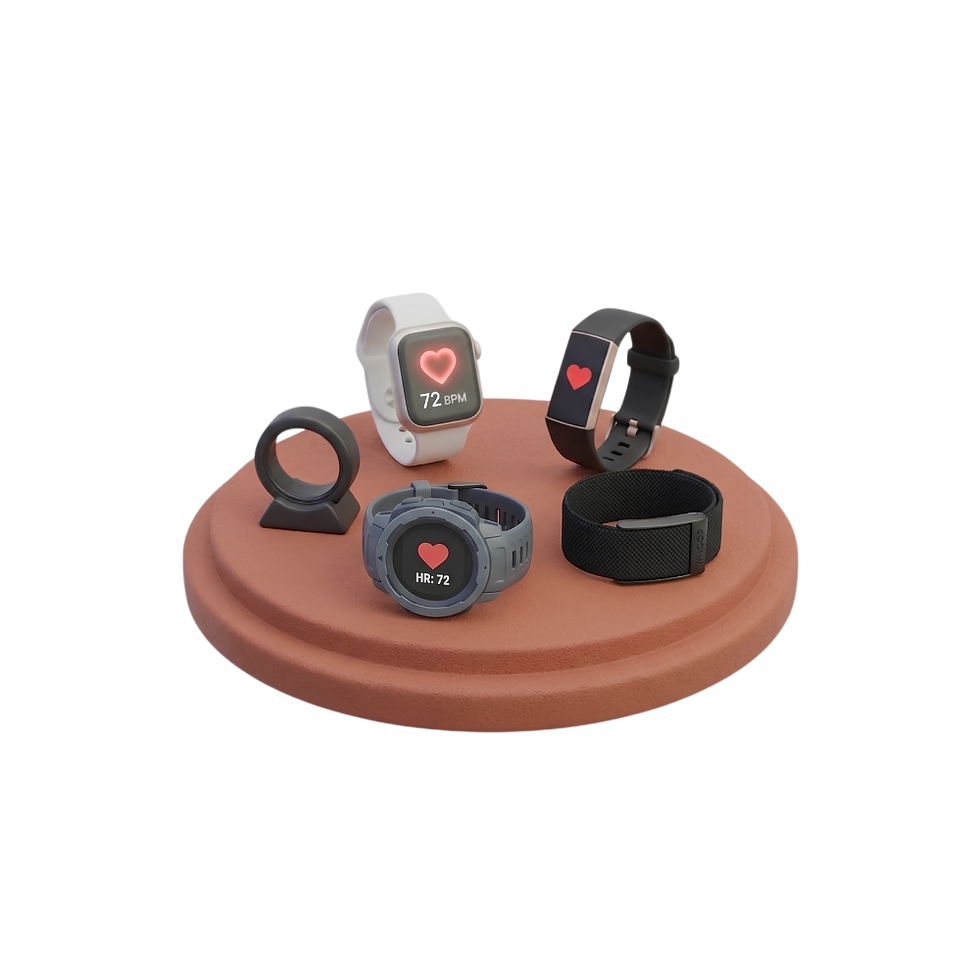
Heart rate monitor accuracy runs from roughly 5.5% to 16.5% median error across the ten devices in the largest single comparison available, and the two extremes are both Fitbits: the Charge 6 at 5.5% and the Inspire 3 at 16.5%. That alone tells you brand is the wrong thing to shop on. Two things matter more than the ordering, though. No device in that study cleared the 5% error threshold this literature normally treats as acceptable. And the same watch that runs 1.2% error during a steady run runs 16.2% during badminton, so what breaks wrist heart rate is not how hard you are working, it is how unpredictably your arms are moving.
I went looking for a clean device ranking and came away convinced no honest one exists, which turned out to be the more useful finding. Here is what the evidence does support.
Want to filter these results by device and activity yourself? Try the heart rate accuracy tool, then read on for what the numbers actually mean.
Heart rate monitor accuracy: 10 devices, grouped in tiers
Cross-study comparisons are mostly noise, because samples, protocols and reference standards all differ. Gielen and colleagues ran ten devices through one protocol against one chest-strap reference, which is the closest thing to a fair test available. Read it as four tiers rather than a ranking, for two reasons given below.
Tier | Device | Median MAPE | Median MAE | Bias | Limits of agreement | CCC |
1 | Fitbit Charge 6 | 5.5% | 4.5 bpm | +0.7 | -11.2 to +12.7 | 0.93 |
1 | Garmin Vivoactive 5 | 6.3% | 5.1 bpm | -1.0 | -18.6 to +16.7 | 0.83 |
1 | Google Pixel Watch 2 | 6.7% | 4.9 bpm | -0.4 | -15.0 to +14.2 | 0.87 |
2 | Apple Watch SE | 7.3% | 5.0 bpm | +0.9 | -21.4 to +23.0 | 0.70 |
2 | Garmin Vivosmart 5 | 8.1% | 7.0 bpm | +4.8 | -15.8 to +25.4 | 0.78 |
3 | Polar Ignite 3 | 11.2% | 9.5 bpm | -4.3 | -31.4 to +22.9 | 0.63 |
3 | Xiaomi Watch 2 | 11.9% | 9.1 bpm | -3.0 | -33.3 to +27.2 | 0.69 |
3 | Polar Pacer | 13.1% | 9.7 bpm | -3.9 | -29.7 to +21.8 | 0.66 |
4 | Oura Ring Gen 3 | 15.0% | 11.0 bpm | -7.1 | -35.5 to +21.3 | 0.61 |
4 | Fitbit Inspire 3 | 16.5% | 14.3 bpm | -14.4 | -51.3 to +22.5 | 0.45 |
Why tiers and not positions? Because the devices were never worn head to head. Participants wore only two watches per session, one on each wrist, so each device rests on ten sessions with ten different people, and only ten of the 45 participants wore the Oura ring at all. On top of that, the Zephyr chest strap used as the reference carries 2.28% to 3.86% error of its own against a real 12-lead ECG, which is wider than the gaps between the top few devices. Positions one through five are not separable, and neither the study nor this page can tell you which is genuinely better.
Model beats brand. The best and worst devices in the study are both Fitbits, three times apart. Any claim of the form "Fitbit is accurate" without a model number carries no information, and the same holds inside Garmin and Polar. Note the contrast is between-subjects here: different people wore each one.
One protocol is not a verdict. The Inspire 3's last place 16.5% is real, and so is the 5.40% that Kitagaki measured on the same device against ECG in cardiac patients. Both are peer reviewed. Protocol and population move these numbers more than hardware does.
The Apple device here is the SE, Apple's budget model, not a flagship. And the protocol itself was light: six minutes sitting, a desk stress task, a 6 km/h treadmill walk and some stop-start walking. No running, no sport, nothing hard.
Nothing here clears the usual acceptability line. The threshold most of this literature uses is 5% error, and the closest device is 5.5%. The honest headline is not who won, it is that nobody crossed the line. The study names the Fitbit Charge 6 and Google Pixel Watch 2 as the only two meeting both its error and agreement standards.
The column that reverses rankings
Here is how easily a table like that misleads. Van Oost and colleagues tested five devices against a real 12-lead ECG and published a completeness column next to the error column.
Device | Median MAPE | Missing data |
Garmin Vivosmart 4 | 4.40% | 49.6% |
Fitbit Sense 2 | 5.61% | 7.6% |
Fitbit Charge 5 | 5.65% | 9.8% |
WHOOP 4.0 | 8.52% | 13.0% |
Withings Scanwatch | 9.34% | 60.9% |
Garmin appears to win. It also threw away half its readings. Withings threw away 61%. A device that drops the hard readings posts a flattering error rate on the easy ones it kept, which is why the two Fitbits are the honest winners here, and how the paper's own prose ranks them. Whenever you see a device accuracy ranking, look for the missingness column. If there isn't one, you are seeing half the story.
Ignore mean bias. It is the number every manufacturer quotes.
Pooled across 22 studies and 1,247 participants, the Apple Watch's mean heart rate bias is -0.27 bpm. That sounds close to flawless. The limits of agreement on the same data are -7.19 to +6.64 bpm. A second independent meta-analysis, covering 56 studies, agrees on the near-zero bias and puts the limits at -11.06 to +10.81.
The Apple Watch SE row above is this problem in one line: third-smallest bias in the table, behind the Pixel Watch 2 and the Charge 6, and the sixth widest limits of agreement.
Read MAPE and limits of agreement, and treat any accuracy claim built on mean bias as incomplete. Newer optical sensors do move the number honestly, though: Apple's Series 6 and later subgroup tightens the limits of agreement to -3.68 to +2.59 bpm, the best pooled figure anywhere in this literature.
What actually breaks wrist heart rate
The popular model says wrist heart rate is fine at rest and falls apart when you push hard. Four independent studies say otherwise. On one device across 77.5 hours of real training, steady running produced 1.2% error and badminton produced 16.2%, roughly thirteen times worse on the same wrists.
The mechanism has been measured directly, not just inferred: activities involving intensive arm movement produced accurate readings only 56.6% of the time, against 78.2% for activities without. Your watch is most wrong when you are doing the dishes, and closest to right when you are running in a straight line.
The full per-activity breakdown, including the cycling contradiction nobody has resolved and the complete absence of per-brand data for lifting, is in heart rate accuracy by activity type.
Night is the easy case, and that is where the marketing numbers come from
A sleeping body is a still body with stable blood flow. It is the friendliest condition this technology ever sees. Dial and colleagues, funded by the Air Force Research Laboratory with no manufacturer ties, tracked 536 nights against a chest-strap ECG.
Device | Nights | MAPE | Bias | Limits of agreement | CCC |
Oura Ring Gen 3 | 470 | 1.67% | -0.88 | -2.84 to +1.08 | 0.97 |
Oura Ring Gen 4 | 138 | 1.94% | -0.94 | -3.75 to +1.87 | 0.98 |
Polar Grit X Pro | 206 | 2.71% | -0.01 | -5.36 to +2.06 | 0.86 |
WHOOP 4.0 | 288 | 3.00% | -1.41 | -4.72 to +1.90 | 0.91 |
One row needs a caveat before you compare it: Polar reports resting heart rate only over the first four hours of sleep, so the reference for that row was recomputed over the same window. It measures a different and earlier slice of the night and should not be ranked against the other three. With that aside, every device here is good, and that is the point.
Notice that the Oura Ring Gen 3 leads overnight and lands in the bottom tier by day.
Heart rate is also the easy part of the night. Sleep staging is far harder, which we covered in the most accurate sleep tracker. For overnight resting heart rate specifically, see why your resting heart rate is suddenly higher.
What the manufacturers claim
Company | The claim | What it rests on |
WHOOP | 99.7% accurate for heart rate | Nocturnal heart rate only, one night, WHOOP 3.0. Scope dropped from the claim, page still live while WHOOP sells the 5.0 |
Oura | Resting HR r-squared 0.996 | A 2020 study whose four authors all hold a dual affiliation with Oura Health. Predates Gen 3, and 0.996 falls to 0.869 for 5-minute segments |
Samsung | 30% more accurate in intensive workouts | Baseline is Samsung's own Galaxy Watch6. No absolute figure, no reference standard, supporting work unpublished |
Google / Fitbit | 40% more accurate for vigorous activity | Pixel Watch 2 only, often misapplied to the Charge 6. No baseline, no reference standard, no published study |
Apple | Within 5 bpm: sedentary 98%, running 88%, walking 87% | 100,000+ sessions, self-published, not peer reviewed. The most transparent disclosure in the category. Its most useful number is rarely quoted: background heart rate is 89% accurate on Series 6 and later, 72% on the SE and Series 4 to 5 |
Polar | Overall MAE 4.4 bpm, strength training 5.8 bpm | Self-published, and the only company publishing its own unflattering numbers |
Garmin | None found | Publishes no numerical wrist heart rate figure anywhere, alone among the major brands |
A note on sources. The most repeated statistic in this category, "the Apple Watch is 90% accurate," misreads its own study. It comes from Wang et al. 2017, where the Apple Watch scored a concordance correlation coefficient of 0.91. A CCC of 0.91 is not 90% accuracy, and the two are not interchangeable. Apple also did not win: the Mio Fuse scored an identical 0.91 and the Polar H7 chest strap scored 0.99, on 2016-era hardware that is now mostly discontinued. This article excludes that figure, along with the WHOOP, Samsung and Google percentage claims above.
Two free levers worth more than an upgrade
Move the watch up your arm. Vermunicht measured the same device at one finger-width above the wrist joint and at three, and moving it up cut error by 11.4 percentage points while raising agreement from 0.59 to 0.92. That is a bigger swing than the gap between first and last place in the ranking table. Going further helps again: an upper-arm optical sensor recorded 1.35% error against 6.82% for a wrist watch in a 2025 comparison, though both devices were the same brand, so placement and hardware are confounded there.
Tighten the strap, within reason. Scardulla varied sensor contact pressure directly and found the signal correlated very weakly with ECG at low pressure, with error falling to roughly 2.4% to 4.6% once contact was firm. The authors state contact pressure affects signal quality more than exercise intensity does. Their device was a research prototype with a load cell rather than a consumer wearable, so trust the direction and not the specific numbers.
Neither lever survives ballistic movement. In a 30-second burpee test, only a WHOOP on the upper arm held bias under 1 bpm, and a Garmin Forerunner 55 on the wrist was off by 33 bpm.
What else moves the number
Rhythm matters most. Among 81 people on a treadmill protocol, those in atrial fibrillation at the time showed 28.7 bpm mean absolute difference at peak exercise against 13.8 bpm in normal rhythm, and devices under-read in 61.2% of cases. It is the rhythm during the reading that matters, not the diagnosis, which is why studies enrolling people with an AF history who happen to be in normal rhythm find nothing.
Tattoos interfere, mostly at rest: 22.9% error over tattooed skin against 2.9% on clear skin of the same arm, narrowing to 5.1% against 2.0% during running. Excluding dropped signals brings the resting figure to 4.2%, so most of that gap is signal loss rather than misreading.
Skin pigmentation shows nothing at rest and something real under load. The pooled meta-analysis finds no significant bias, but its dark-pigmentation estimate rests on a single study whose limits of agreement are twice as wide as the light-skin ones, which is low precision rather than proven equivalence. The strongest current-hardware evidence is Chase 2024, which put an Apple Watch Series 9 on 30 people during treadmill walking. Mean bias ran -0.88 bpm for the lightest Fitzpatrick group and -8.35 bpm for the darkest, and the limits of agreement widened 4.6-fold, from a 14.81 bpm spread to 67.81 bpm. The darkest group was six people and pigmentation was self-reported, so hold the size loosely and the direction firmly. A separate study found medium and dark skin off by about 11.7 to 11.8 bpm above 60% of heart rate reserve, with no group differing at rest. Note this is the opposite of SpO2, where pigmentation bias is well established.
Wrist hair does not appear to matter. Hair density was not significantly associated with accuracy in the only study to test it, and every strong claim about hair traces to manufacturer guidance rather than research.
And most devices have never been tested at all. An umbrella review of 310 consumer wearables found only about 11% validated for even one biometric outcome, with the studies conducted representing roughly 3.5% of what is needed. Validation lags release by two to four years, so the Apple Watch Series 11, WHOOP 5.0, Oura Ring 5, Galaxy Watch 8, Garmin Fenix 8 and Pixel Watch 4 currently have none. One generation's result does not transfer to the next, since firmware changes results on identical hardware. The bright spot is Samsung: Kim 2023 put a Galaxy Watch 4 on 44 cardiac patients against a hospital 12-lead ECG and recorded an ICC of 0.997, the strongest single result in this literature, though agreement drops to 0.867 once heart rate passes 160 bpm.
Knowing the error bar is only half of it
An honest error bar tells you how much to trust a single reading. It does not tell you what is moving your numbers week to week, and no study average can, because that answer is specific to you.
Kygo pulls heart rate, HRV, resting heart rate and sleep from Oura, Apple Health, Health Connect, Fitbit, Garmin and WHOOP, then correlates them against what you actually ate, so real patterns separate from noise in weeks instead of never. Free on iOS and Android.
Common questions
Which wearable is most accurate for heart rate?
The Fitbit Charge 6, at 5.5% median error in the largest single comparison available. Overnight, the Oura Ring Gen 3 leads at 1.67%. But that study rotated two watches per participant rather than putting all ten on everyone, and the chest strap reference carries its own 2.28% to 3.86% error, so read the results as tiers rather than a ranking. The best and worst devices in it were the same brand.
Is wrist heart rate accurate enough to train with?
For steady-state cardio, yes. Running produced 1.2% error in the best real-world study available. For intervals, racquet sports, rowing or lifting, a chest strap or upper-arm sensor is substantially more reliable, with wrist errors in those activities reaching 13% to 17%.
Why does my watch show a lower heart rate than I expect during a workout?
Under-reading is the usual failure direction during irregular arm movement. One wrist device under-read by 16.5 bpm during badminton and soccer. If your arms are moving unpredictably, expect the number to come in low.
Does a chest strap actually beat a wrist watch?
In most conditions, yes, though a strap is not perfect either at 2.28% to 3.86% error against 12-lead ECG. Its advantage is modest at rest and widens sharply once your arms start moving.
Is a smart ring more accurate than a watch?
It depends entirely on when. The Oura Ring Gen 3 posts 1.67% error overnight, better than any watch in the same study, and sits in the bottom tier during mixed daytime movement in another. Placement is not what decides it. Motion is.
Does how tight I wear my watch matter?
Yes, more than most people expect. Contact pressure affected signal quality more than exercise intensity did in one controlled study, and moving a watch three finger-widths above the wrist joint cut error by 11.4 percentage points in another. Both changes are free.
Do tattoos affect heart rate readings?
At rest, substantially: 22.9% error over tattooed skin against 2.9% on clear skin of the same arm. Most of that gap is dropped readings rather than wrong ones, and the penalty shrinks during running.
Has my current watch been independently tested?
Probably not. About 11% of consumer wearables have been validated for even one biometric outcome, and validation lags release by two to four years.
The bottom line
Wrist heart rate is good technology doing a hard job. It is close to excellent when you are still or moving predictably, and it degrades sharply when your arms move unpredictably. Intensity is not the variable that breaks it.
So judge a device on its MAPE and limits of agreement, never on mean bias. Check for a missingness column before trusting any ranking. Assume a manufacturer accuracy claim came from sleep data until shown otherwise. And before you spend anything, move the device up your arm and tighten the strap, because placement moves accuracy more than most upgrades do.
Then the harder question is what your own numbers actually respond to. Kygo ties your wearable's heart rate, HRV and recovery data to what you eat, so the patterns are yours rather than a population average. Get it free on iOS or Android, or start at www.kygo.app. If HRV is your metric, our breakdown of what actually improves HRV ranks the levers by evidence quality.
Key sources: Gielen 2026 (JMIR Form Res, ten devices, rotated design), Van Oost 2025 (Sensors, 12-lead ECG with completeness data), Dial 2025 (Physiol Rep, AFRL-funded, 536 nights), Kim 2023 (Ann Rehabil Med, Galaxy Watch 4 vs 12-lead in cardiac patients), O'Grady 2024 (Sensors, Apple Series 9 and Ultra 2 resting HR), Nissen 2022 (JMIR Form Res, ten tasks vs Holter), Higuchi 2025 (J Phys Ther Sci, Inspire 3 vs ECG), Inoue 2026 (JMIR Cardio, Galaxy Watch 6, Samsung-funded), Lambe 2026 (npj Digit Med, Apple Watch living review), Choe 2025 (Physiol Meas meta), Fuller 2020 (JMIR mHealth review), Doherty 2024 (Sports Med umbrella), Miller 2022 (Sensors, WHOOP-supported lab), Liang 2024 (Sensors, Oura nocturnal), Kitagaki 2025 (JMIR Cardio), Ceugniez 2025 (JMIR mHealth, by activity), Vermunicht 2025 (Eur Heart J Digit Health, wear position), Schweizer 2025 (JMIR Cardio, placement), Moghaddam 2026 (Sensors, ballistic movement), Scardulla 2020 (Sensors, contact pressure), Wang 2017 (JAMA Cardiol), Quinn 2024 (JACC, atrial fibrillation), Navalta 2025 (Sensors, tattoos), Chase 2024 (J Funct Morphol Kinesiol, skin tone on Series 9), Hung 2025 (PLOS ONE, skin tone), Singh 2024 (JMIR meta, pigmentation), Koerber 2023 (J Racial Ethn Health Disparities). Manufacturer material: Apple, Polar, WHOOP, Oura, Samsung, Google.
Disclaimer: Kygo is a personal data aggregation and insights platform designed for informational purposes only. The information provided by Kygo, including correlations, patterns, and trends identified in your data, does not constitute medical advice, diagnosis, or treatment. Always consult a licensed healthcare provider with any questions regarding medical conditions.
If you have ever put a chest strap on alongside your watch, which activity showed the biggest gap? That is the one I would want to see.